

If you are curious about reflex sight vs. red dot sight, which one should you go for, you came to the right place! In this article, we will explain the differences between reflex sight vs. red dot sight, and you can make the call on which one suits you better! Are you ready? Here we go!
All reflex sights are red dot sight, but not all red dot sights are reflex sights
Surprise! Here’s the answer you’ve been wondering! The reflex sight is one kind of the red dot sight, and there are 3 kinds of red dot sights on the market. All of them serve different purposes and are used under various circumstances. This paragraph will introduce you to all 3 kinds of red dot sights.
Prism sights

Low fixed magnification
Prism optics are generally stout optics that are at low fixed magnification. Unlike traditional scopes, prism optics utilize a prism to focus lighting to the user’s eye. On the other hand, traditional optics act much like a regular telescope focusing an image onto a single point.
Prism scopes benefit from featuring an etched reticle that Prism scopes can utilize with or without batteries. This adds to the versatility of the optic as you can pick a reticle that best suits your needs and scrapping battery dependency. However, the prism design will not be able to have variable magnification.
You will need to select the magnification range that best suits your needs, whether 1x, 3x or 5x. In addition, the prism optic will not allow the unlimited eye relief found on reflex sights. You will have to have your head in the proper position to obtain a sight picture. So, keep in mind you will likely have to mount the optic further rearward to achieve your desired eye relief.
Another positive for the prism optic is that it typically comes with a diopter. This allows the shooter to adjust the focus of the optic to the shooter’s particular eye. This is especially handy if you have astigmatism, as traditional red dot options appear too blurry to the shooter’s eye.
Holographic sights
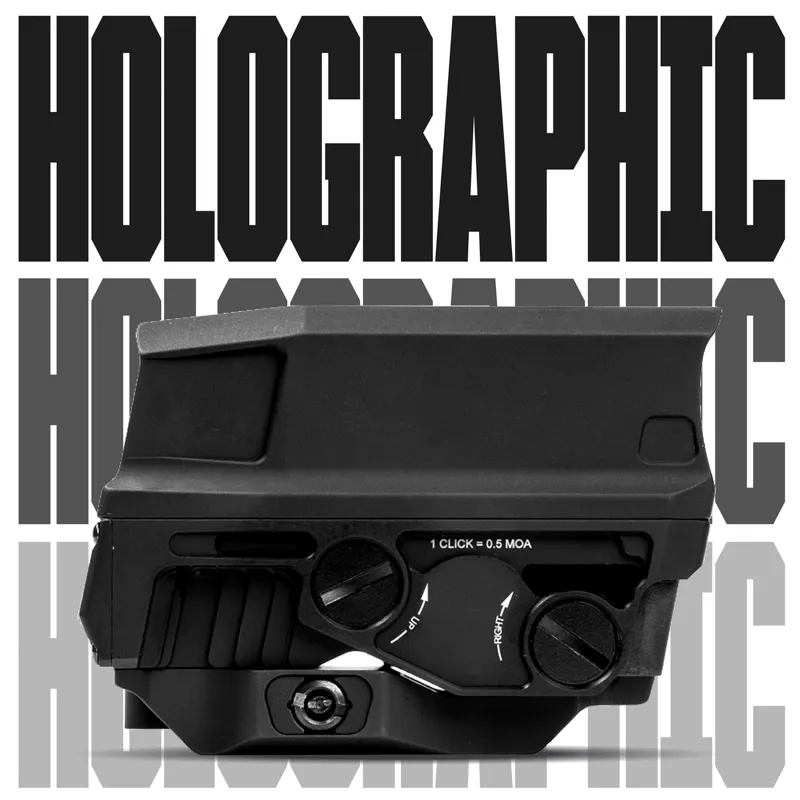
Holographic sights
Although the reticle of a holographic sight may look like that of a reflex sight, they operate on much different technology.
Holographic sites use a laser diode that is then reflected through mirrors that allow the projection of an illuminated pattern. The reticle will appear to be floating over your target instead of appearing on separate planes found with reflex sights. This will allow you to focus on both your target and reticle simultaneously without one or the other getting blurred out. This also makes them less likely to have any parallax distortion.
The holographic sight also has an advantage if you plan on using a magnifier in conjunction with your optic. When utilizing a reflex sight and a magnifier, your dot size will increase by however many times you magnify it. For example, a 2 MOA dot magnified by a 3X magnifier will now be 6 MOA. Not ideal for precise shot placement if it’s a long-distance shooting. The holographic sight does not inherit this issue. If you have a 1 MOA holographic sight and magnify it by 3, your dot size will still be 1 MOA. If battery life and some extra size are not of concern to you, the holographic sight does offer some real advantages over the reflex sight. It will be a viable option for the majority of shooters.
Reflex sights
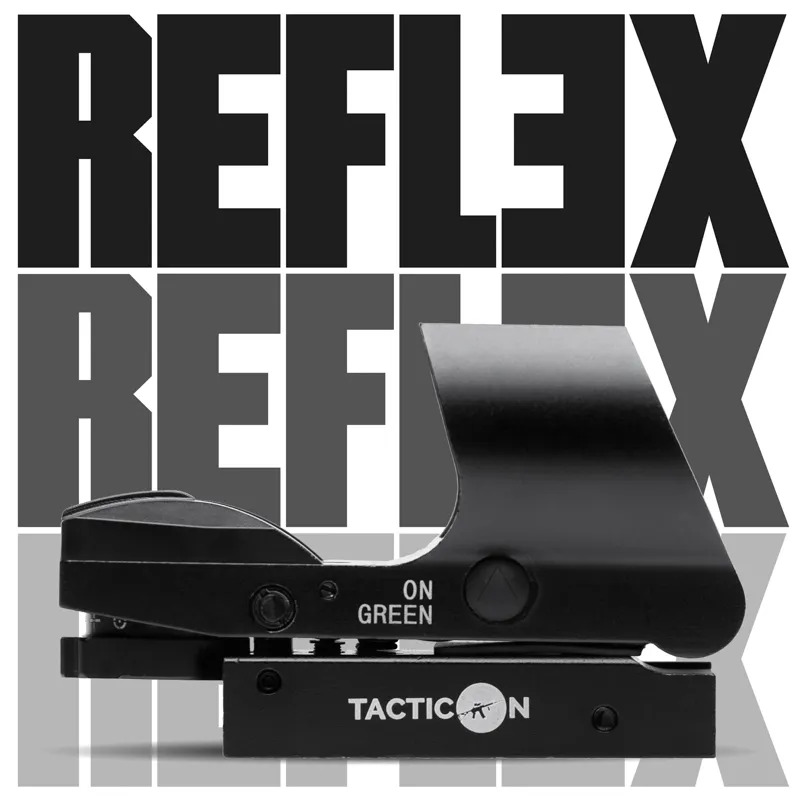
Reflex sights
A reflex sight, also known as a reflector sight, operates utilizing an LED emitter that reflects light off a pane of glass back to the shooter’s eye. This method is very battery efficient and makes for some of the longest-lasting battery life in the industry. These optics can last up to 5 years of continuous use on a medium brightness setting.
You will not find the same power efficiency on other holographic or etched reticle systems. Due to the compact nature of the internals of the reflex sight, they can be made to be very compact. This adds a great deal of versatility to the optic as they can be effectively used on both rifles and pistols. The window of these optics is essentially just that, a window. This allows the optic no eye relief and minimal parallax, making for a speedy and flexible system when shooting around barricades or from other unconventional shooting positions. If you want a durable, long-lasting, lightweight option for your following optic, the reflex sight has been proven around the world to be a perfect choice.
Reflex sights or not? Based on what firearm you have!

What firearm do you own?
SO which do you choose? If you will use a magnifier, the Holographic is probably the better option. If you want something light and low maintenance, the reflex sight is your best bet. Both optics are very intuitive and easy to shoot fast and accurately. You may find utilizing the Holographic sight a more natural experience as you will benefit from the reticle appearing to float over the target, creating less work for your brain.


